Article The First
 |
| 1790 printing of the 12 Amendments proposed by a Joint Resolution of the First Federal US Congress on September 25, 1789 |
“After the first enumeration required by the first article of the Constitution, there shall be one Representative for every thirty thousand ... until the number of Representatives shall amount to 200; after which the proportion shall be so regulated by Congress, that there shall not be less than 200 Representatives, nor more than one Representative for every fifty thousand persons.”
 |
| "Article The First" name as written in the engrossed 12 Amendments, now known as the Bill of Rights, passed by the first bicameral U.S. Congress - Image courtesy of the National Archives |
 |
| Article The First's entire text as written in the engrossed 12 Amendments, now known as the Bill of Rights, passed by the first bicameral U.S. Congress - Image courtesy of the National Archives. |
If the Article the First Amendment had been ratified along with the other 11 Amendments then the U. S. House Representatives would have been limited to a 1/50,000 member/maximum citizen ratio. Instead, the number of citizens in the ratio has expanded with each new census, courtesy of the Apportionment Act of 1911 [1] and the subsequent Permanent Apportion Act of 1929, to a 1/710,767 member/citizen ratio arrived by dividing the 2010 April US Census population of 309,183,463 by 435, the current House of Representatives membership number.


 |
| 2010 Congressional Apportionment population of 309,183,463 submitted "To the Congress of the United States: Pursuant to title 2, United States Code, section 2a(a), I transmit herewith the statement showing the apportionment population for each State as of April 1, 2010, and the number of Representatives to which each State would be entitled. BARACK OBAMA, THE WHITE HOUSE, January 5, 2011." |
By a series of public laws, the House of Representatives has been capped at 435 members, with each elected official now representing 710,767 citizens. This limitation on the expansion of the House of Representatives began on August 8, 1911, when President William H. Taft (R) signed the Apportionment Act of 1911, increasing House membership from 391 to 433. The act also included provisions to add two more members when New Mexico and Arizona became states. The legislation took effect on March 13, 1913, during the 63rd Congress (1913–1915).
Debating the bill, many members raised concerns that the House was growing to an unwieldy size. Republican Representative Edgar Crumpacker of Indiana, however, who chaired the House Committee on the Census, argued just the opposite:
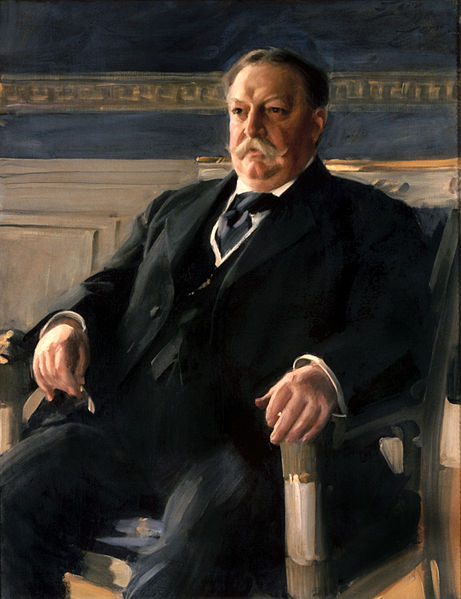 |
| President William Howard Taft White House Oil |
Debating the bill, many members raised concerns that the House was growing to an unwieldy size. Republican Representative Edgar Crumpacker of Indiana, however, who chaired the House Committee on the Census, argued just the opposite:
Members are . . . supposed to reflect the opinion and to stand for the wishes of their constituents. If we make the ratio [of persons per Representative] too large the idea of representation becomes attenuated and less definite. The personal interest of the voter in his representative becomes less important to him, and we may lose something of the vital strength of our representative form of government.
 |
| Eight-term Republican Congressman, Edgar Crumpacker of Indiana chaired the Committee on Census for three terms |
Congress, however, failed to re-apportion the House for the first time after a decennial census in 1920 because the members could not agree on a plan and the US Constitution, without the enactment of Article the First, was vague calling only for at least one Representative per state and that no more than one for every 30,000 persons. Previously, the House reapportioned itself in a manner that expanded the representation of the early Congresses. The previous methods for calculating apportionment by the 1920’s, however, caused the smaller rural states to lose representation to the growing larger urbanized states. A political battle erupted between rural and urban factions resulting in no reapportionment following the 1920 Census.
 |
| Republican Majority Leader John Q. Tilson |
It was not until the eve of the next census that Republican Majority Leader John Q. Tilson of Connecticut, took the lead in developing a House reapportionment plane for the 1930's. In direct opposition to the founders 1789 Article The First Amendment, Tilson led the effort to pass the Permanent Apportionment Act of 1929, fixing the number of Representatives at 435. He argued that this new act dispelled “the danger of failing to reapportion after each decennial census, as contemplated by the Constitution.”
 |
| Herbert Hoover was President during the enactment of the Permanent Apportionment Act of 1929 |
William B. Bankhead of Alabama, in opposition, described the plan as “an abdication and surrender of vital fundamental powers.” In 1941, Congress adopted the current formula for reapportioning House seat districts still limiting the House of representatives to 435 members (See 54 Stat.L. 761, November 15, 1941), where it has remained, except for a temporary increase to 437 Members from 1959 to 1961 after Alaska and Hawaii achieved statehood.
Consequently, every two years Congressional incumbents and challengers now raise millions of dollars to reach 710,767 citizens to win or retain their seat in the House of Representatives. Article the First’s ratification is necessary to restore citizen synergy to the House of Representatives.
 |
| How to Persuade 710,767 Citizens Every Two Years to a "Elect Me" to the House of Representatives |
It is historically apparent that the 1911 and 1929 Republican Congresses ignored the lessons learned by the framers of the 1787 U.S. Constitution. The 1787 framers and 1789 Congress, who participated in the unicameral governments of three earlier republics [3], dutifully invented and enacted a tripartite system of government in which no one branch (legislative, judicial or executive) would be more powerful than another. The framer's Constitution of 1787 also curtailed the power of the federal government by empowering the state legislatures to check the U.S. Senate:
The Senate of the United States shall be composed of two Senators from each State, chosen by the Legislature thereof,for six years; and each Senator shall have one vote.
Finally the Constitution of 1787 provided a mechanism for "We The People" to check the federal government with the House of Representatives being "composed of members chosen every second year by the people of the several States" and the number of members being "apportioned among the several States" according to their population.
 |
Constitution of 1787 Checks and Balances: "Nothing checks ambition better than ambition." - Economic Home Runs, ROI.us Corporation, Tampa, Florida, 2008, page 28
|
The First bicameral U.S. Congress understood that the mechanism of U.S. Senators being held accountable to their state legislatures [4] was protected by Article I Section 3 of the Constitution of 1787. They also knew that the initial House member-per-citizen ratio of about 30,000 to one, which had been hotly debated at the Constitutional Convention, was not protected in the same constitution. The debate of a constitutional cap on the "citizens per member ratio" resumed in the 1789 U.S. Congress. The founding Congress was determined that its House of Representatives remained a creature of the people and not of special interest or wealthy candidates.
On September 29th, 1789, Congress voted to send 12 Constitution of 1787 Amendments to the states for ratification. Amendments 3-12 (the Bill of Rights)[5] were enacted on December 15th, 1791, Amendment Two was enacted on May 18th, 1992,[6] but the Amendment that Congress issued in the first position, Article the First,[7] was not approved with the Bill of Rights due to a clerical error.[8] Had Article the First been inscribed properly there would have been one member of the House of Representatives for every 50,000 citizens, rather than the 2010 ratio of one member per 710,767 citizens.[9]
For More Information go to
America's Four United Republics
America's Four United Republics
It is important to note that Article the First, despite the clerical errors, was ratified by eleven state legislatures by 1792.[10]
A 12th state would have met the 1792 4/5ths ratification requirement and thus forbade the Apportionment Apportionment Act of 1911 and Permanent Apportionment Act of 1929 enactments. There is an active case challenging the current Congress to accept a timely 12th state ratification before the US 3rd District Court of Appeals.[12] This case argues that Connecticut's legislature, the required 12th state, ratified Article the First, in two different legislative sessions with the last occurring on May 10, 1790.[11]
- Virginia on November 3, 1789
- New Jersey on November 20, 1789
- Maryland on December 19, 1789
- North Carolina on December 22, 1789
- South Carolina on January 19, 1790
- New Hampshire on January 25, 1790
- New York on March 27, 1790
- Rhode Island on June 15, 1790
- Pennsylvania on September 21, 1791
- Vermont on November 3, 1791
- Kentucky on June 24, 1792
A 12th state would have met the 1792 4/5ths ratification requirement and thus forbade the Apportionment Apportionment Act of 1911 and Permanent Apportionment Act of 1929 enactments. There is an active case challenging the current Congress to accept a timely 12th state ratification before the US 3rd District Court of Appeals.[12] This case argues that Connecticut's legislature, the required 12th state, ratified Article the First, in two different legislative sessions with the last occurring on May 10, 1790.[11]
It is highly unlikely, however, that the US 3rd District Court of Appeals will overturn the Federal District Court's decision to dismiss the Connecticut Article the First lawsuit. Article the First, therefore, remains before the states for their consideration but now needs 4/5ths of 50 states for enactment, like Article the Second achieved in 1992.[13] Therefore, the Permanent Apportionment Act of 1929 will continue to limit the size of the HR membership unless U.S. citizens come together and demand Congress lift the 435 HR limit or the remaining States vote to ratify Article The First.
Fortunately, lifting the 435 HR member limit DOES NOT require a constitutional amendment. The HR can be restored to a 50,000 to 1 citizen/member ratio with the simple passage of a Congressional public law.
What follows is a case, for your consideration, to restore the House of Representatives to a 50,000/1 citizen/member ratio. The two options to accomplish this are:
Either way, the new law(s) will restore the “government of the people, by the people, for the people,” [2] back to the citizens of the United States.
- Lobby the current Congress to repeal of the Permanent Apportionment Act of 1929 and enact Article The First's 1/50,000 member/citizen apportionment ratio in its place.
- Organize a letter writing campaign and State Legislature lobbying efforts to ratify Article the First following the model utilized in the ratification of the 27th Amendment, Article the Second, in 1992.
Either way, the new law(s) will restore the “government of the people, by the people, for the people,” [2] back to the citizens of the United States.
In order to understand why the 1911 and 1929 Apportionment Acts have been so problematic, it is important to reflect on the Sixteenth Amendment that predated limiting the house to 435 members. Income Tax, despite the remonstrations of many Republican pundits and politicians,[14] was not the brainchild of Woodrow Wilson but of Abraham Lincoln, whose congress enacted the Revenue Act of 1861 as a temporary measure to fund his government during the Civil War. Income tax remained in force after the war, funding reconstruction until the Supreme Court declared the Income Tax Bill of 1894 unconstitutional in Pollock v. Farmers' Loan & Trust Co (1895).
Fifteen years later, another Republican U.S. President would champion federal income tax, this time as an amendment to the Constitution of 1787. Specifically, President William Howard Taft, in an address to Congress, proposed a 2% federal income tax on corporations by way of excise duties. The President also proposed, on June 16th, 1909, a constitutional amendment to legalize income tax. Less than a month later, the resolution now known as the Sixteenth Amendment, was passed by the 61st U.S. Congress with Speaker of the House Joseph Gurney Cannon (R-Ill) & Vice President James S. Sherman (R-NY) executing the Joint resolution.[15]
 |
| 16th Amendment that is currently stored in the National Archives |
The state legislatures considered the Sixteenth Amendment during the presidential election of 1912 between William Howard Taft (Republican Party), Theodore Roosevelt (Progressive Party) and Woodrow Wilson (Democratic Party) who were all advocates of a federal income tax. U.S. Senator Robert Lafollette’s National Progressive Republican League supported Theodore Roosevelt over Taft. The splitting of the Republican Party resulted in the election of Woodrow Wilson. And the 16th Amendment, on February 25, 1913, was ratified by 4/5th’s of the States. Shortly thereafter, the new Democrat-controlled Congress passed the Revenue Act of 1913, which was enacted with President Wilson’s signature on October 3rd, 1913. The enabler of the current federal income tax system, therefore, was not Woodrow Wilson but the Taft Administration and the Progressive Republican Congress.
The Revenue Act of 1913 implemented a federal government tax that eventually would shift the balance of financial power between the federal government and the States to the bicameral U.S. Congress. Today the States often find themselves in a position where the choice is either to adopt U.S Congressional legislation as a state law or to lose federal funding.[16] Under this new configuration, “the people” are now governed primarily by federal, as opposed to State, laws.
Additionally, the Sixteenth Amendment is a revenue law that remains subject to Constitution of 1787, Article I, Section Seven which states: “All Bills for raising Revenue shall originate in the House of Representatives; but the Senate may propose or concur with Amendments as on other Bills.”Therefore, power of income tax revenue bequeathed to the U.S. Bicameral Congress by the Sixteenth Amendment must originate from the House of Representatives. Additionally, since 1913 the tax codes that have sprung from the Sixteenth Amendment are so complex and time-consuming that more than 50% of Congressional members’ time is spent on revenue bills. Indiana University’s Center of Congress reports:
The work involved in doing this is arduous, and — a reflection of its importance — it is the single most time-consuming thing Congress does. One veteran observer of Congress, asked to estimate how much time Members spend on budgetary matters, replied: "Almost all." That's an exaggeration, but it may not seem like it during those many weeks each year when Congress is preoccupied with the budget resolution or the appropriations bills. In recent decades, about half of all House roll call votes have been budget-related; in the Senate the percentage is even higher.[17]
Therefore, one can understand how much more important it is in 2012 for the House of Representatives to be truly accountable to We The People versus in 1789, when the first bicameral U.S. Congress had no income taxing authority over U.S. Citizens.
Having addressed the implementation of the Sixteenth Amendment,[18] we now turn to a scrutiny of the 1911 and 1929 Apportionment Acts and their impact on We The People’s check over the House of Representatives.
The 112th U.S. Bicameral Congress has earned one of the lowest constituent approval ratings in U.S. History. This should be no surprise, since, in recent years, the dislike and distrust of the federal government has spawned protest movements ranging politically from the “Tea Party” to “Occupy Wall Street,”[19] Why do such diverse political groups overwhelmingly disapprove of Congress?
The answer is that the people have lost their representative government to the political power of special interests, corporations, an exceptionally partisan two-party system, and candidates of extraordinary wealth and/or fame – primarily due to the enactments of the 1911 and 1929 Apportionment Acts.
The original Tea Party, held in Boston Harbor on December 16, 1773, was a direct action by Bostonian colonists against the British government because Parliament had imposed tea “Taxes upon the People, without their Consent…” The words, “No Taxation Without Representation,” were never uttered in the 18th Century but the 19th Century slogan does sound-bite one major colonial grievance that sparked the American Revolution. The 21st Century “Tea Party” Movement seized on this familiar catch phrase and its Boston image of colonial defiance as its mantra in an attempt to enact numerous political measures. For this new Tea Party, the “boat” is sitting in a pool of water in front of the House of Representatives with the 1911 and 1929 Apportionment Acts, not tea, as its cargo.
More recently, the Occupy Wall Street movement that began in New York on September 17th, 2011, in the Wall Street financial district’s Zuccotti Park, also leveled charges against the U.S. Congress. Social and economic inequality were Occupy Wall Street’s refrain, along with the charge that greedy and corrupt corporations have undue influence on the U.S. government. This undue influence, however, is not just a creation of Wall Street but a product bestowed upon all the people of the United States courtesy of the 1911 and 1929 Apportionment Acts.
The Declaration of Independence signer Samuel Adams and his Virginia colleague, fellow signer and USCA President Richard Henry Lee, would disagree with the Tea Party's plan to address the inequities of the current U.S. Representative government because they accept a HR of 435 members. For the same reason, the Adams-Lee Coalition would also disagree with the Occupy Wall Street protesters who blame the private sector for the nation’s ills. Richard Henry Lee, however, would agree that elite politicians pose a challenge and that they have been enabled by the Apportionment Act of 1911. Lee warned in 1787 that the new Federal government, without a Bill of Rights, would "… produce a coalition of monarchy of men, military men, aristocrats and drones, whose noise, impudence and zeal exceed all belief.” [20]
Has the enactment of the House Apportionment Acts and the Seventeenth Amendment produced a “coalition of monarchy” in the U.S. Bicameral Congress?
The answer, according to both the Tea Party and Occupy Wall Street, is a resounding YES!
The answer, according to both the Tea Party and Occupy Wall Street, is a resounding YES!
In 1774 and again in 1775, the United Colonies Continental Congress, in its disgust with Parliament’s laws and policies, proposed plans and ideas to improve the colonial representative structure within the Parliamentary system of Britain’s government. What potent system changes does either the Tea Party or Occupy Wall Street offer to correct a political system in which special interest groups, millionaires, and a broken two-party system -- rather than constituents– hold power over the House of Representatives? Tea Party “term limits” and Occupy Wall Street’s “campaign finance reform” are proposed but each is merely a Band-Aid to a severed limb that has usurped the People’s check over the House of Representatives. The cure citizens seek, from the Green Party to the Tea Party, from Occupy Wall Street to the Libertarian Movement, can be readily administered with the repeal and replacement of the 1911 and 1929 Apportionment Acts with Article The First’s 50,000/1 citizen/member ratio.
In 1787, framer James Madison argued that a strong federal system was needed to govern the United States. The new constitution was constructed in the knowledge that nothing checks ambition better, in a free enterprise society, than ambition. The 1789 House of Representatives, whose members’ numbers were based on population, were considered to be the voice of the people. There were pro-federalist delegates who argued for each House member to represent 50,000 of the population, while more liberal framers sought one House member for each 10,000 to 20,000 citizens. “The number of representatives shall not exceed one for every 30,000” was the compromise adopted in 1787 by convention delegates. In 1789, the first U.S. Bicameral Congress, to insure the House of Representatives remain accountable to We The People, enacted Article the First, limiting each Congressional District to a population of not more than 50,000 citizens.
The major concern of the 1787 framers was that the people would want more members in Congress and not fewer. The outcry against the 1/30,000 representative/citizens ratio as too small was too strong. James Madison, faced with losing Constitution of 1787 ratifying votes, was forced to address the People of New York in an Independent Journal essay, stating:
The true question to be decided then is, whether the smallness of the number, as a temporary regulation, be dangerous to the public liberty? Whether sixty-five members for a few years, and a hundred or two hundred for a few more, be a safe depositary for a limited & well-guarded power of legislating for the United States ?The number of which this branch of the legislature is to consist, at the outset of the government, will be sixty-five. Within three years a census is to be taken, when the number may be augmented to one for every thirty thousand inhabitants; and within every successive period of ten years the census is to be renewed, and augmentations may continue to be made under the above limitation. It will not be thought an extravagant conjecture that the first census will, at the rate of one for every thirty thousand, raise the number of representatives to at least one hundred. … it can scarcely be doubted that the population of the United States will by that time, if it does not already, amount to three millions. At the expiration of twenty-five years, according to the computed rate of increase, the number of representatives will amount to two hundred, and of fifty years, to four hundred. This is a number which, I presume, will put an end to all fears arising from the smallness of the body.[21]
Based on Madison’s projections, there would be 10,290 [22] Representatives to the 21st Congress and not the current 435 -- and Madison was prognosticating in a period when minorities, women, and 18-20 year olds did not have the right to vote!
The 1790 Census reported 3,808,096 citizens, and, after congressional state reapportionment, the House of Representatives convened with 105 Members, or one person representing 36,266 citizens. Women, slaves and minors (under 21) counted in the census were not permitted to vote, which left a pool of 843,554 men, with a ratio of 1 House member for 6,034 eligible voters. These small constituent numbers meant that 18th century citizens knew their representatives personally.
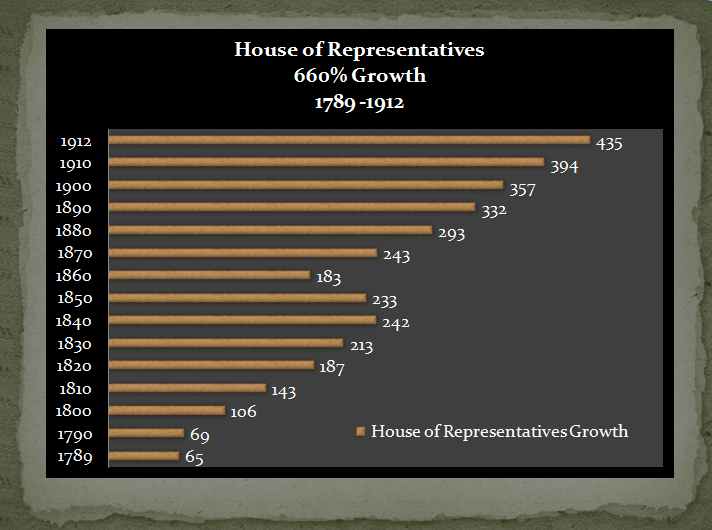 |
Throughout the first 123 years, the House of Representatives
grew in numbers by 670% with the increasing population.
Economic Home Runs, ROI.us Corporation, Tampa, Florida, 2008, page 58
|
Throughout its first 123 years, the House of Representatives grew in numbers by 670%, which was below the numbers prescribed by Article the First. Despite those statistics the House somewhat stayed the framers’ course. Political parties rose and fell in the House because the individual representatives’ small constituent base meant that established party incumbents could be readily ousted.
 |
| From 1912 to 2012 the U.S. House of Representatives had no growth despite the population increasing from 92,228,496 to 308,745,538.Economic Home Runs, ROI.us Corporation, Tampa, Florida, 2008, page 58 |
The Pre-Apportionment Act House of Representatives was not part of a political system that habitually reelected incumbents backed by personal wealth, special interest money, and an incredibly powerful two-party nominee system. Because this House of Representatives was filled with members responsible to a small number of constituents, its new members birthed a formidable new political party about every two decades.
 |
1789-1912 House of Representatives with Political Parties over 5%
Economic Home Runs, ROI.us Corporation, Tampa, Florida, 2008, page 59
|
In 1911, however, the Progressive Republicans changed this situation by limiting the number of House Members to 435. Since 1912, U.S. citizens have had only two parties with more than 5% in the House of Representatives.
 |
Parties in the 1913 - 2013 House of Representatives with over 5%
Economic Home Runs, ROI.us Corporation, Tampa, Florida, 2008, page 58
If we take a hard look at the numbers, it first appears that the pre-apportionment act ratio has dropped to 1/223,500 versus the 1/707,759 of today.[23] Women, however, did not have the vote, so the U.S. House member/male citizen ratio was 1/111,750. Moreover, if you remove the male citizens under 21 (who also were not eligible to vote), the Member/per eligible voter ratio drops to 1/62,618. In 1912, members were still accountable to a relatively small number of eligible voter constituents.
|
 |
1910 House of Representatives Members funded
a campaign to reach 63,000 Eligible Voters Economic Home Runs, page 60 |
Today, with the U.S. House Member/Citizen ratio at 1/710,767 it is a vastly different Congress. Thankfully, the Nineteenth, Susan B. Anthony, Amendment, belatedly granted women suffrage in 1920 but in 1911 the act was passed with a member/per eligible voter ratio at 1/62,618 versus 1/539,223 in 2012.[24] Therefore, a candidate for the US House in 2012 must fund a campaign to reach 540,000 eligible versus 63,000 in 1912, one hundred years earlier. It is virtually impossible for a member to get to know even the opinion leaders of 540,000 eligible voters let alone the constituents themselves.
 |
2010 House of Representatives Members funded
a campaign to reach 540,000 Eligible VotersEconomic Home Runs, page 60 |
The 1911 and 1929 Apportionment Acts, then, have significantly limited the people’s ability to meet, and exchange of ideas with their representative in the House of Representatives. This limitation of access has greatly attenuated individual citizen rights to participate in the legislative process and thereby to check the federal government. The 1911 and 1929 Apportionment Acts, more so than any other law, is responsible for the rise of both Occupy Wall Street and the Tea Party in 21st Century politics.
How, specifically, has restricting the U.S. House members to 435 consequently limited individual power?
The HR members need no longer concern themselves with individual constituents due to the massive numbers of citizens in each Congressional District. 2012 door to door campaigning by a candidate or representative is fruitless except as a public relations ploy aimed at attracting TV or viral internet cameras. Mass media, not personal contact, is needed to reach 540,000 eligible voters. Moreover, incumbents and challengers alike – especially if they are unknown to the public -- must now raise millions of dollars to reach the over half a million eligible voters in their districts every two years. Accordingly, PACS, 527s, unions, corporations, the media, and unprecedented personal wealth are all key components of a successful candidacy.
The possibility of a viable middle class candidate, running a successful campaign, on ideas and issues, is a pipe dream. The Apportionment Act of 1911 has empowered special interests, a highly partisan two-party system, the media, and citizens with great personal wealth to control the House of Representatives. The Apportionment Act of 1911 is major impediment to restoring the “government of the people, by the people, for the people,” back to the people of the United States.
From 1790 to 1911, before the Apportionment Act of 1911's enactment, 20 different parties obtained House membership exceeding 6%. During 1790 to 1911, nine different parties were the largest in their respective Congresses. After enactment of the Apportionment Act of 1911, however, only two parties in the most recent century, 1912 to 2012, can claim to have held more than 4% of, let alone a majority in, the House of Representatives. The mechanism for birthing parties, then, was the second casualty of the 1911 and 1929 Apportionment Acts.
 |
1789-1912 House of Representatives with Political Parties over 5% Economic Home Runs, ROI.us Corporation, Tampa, Florida, 2008, page 59 |
If the citizens of the United States truly seek a mechanism to break the two-party stranglehold, end partisan politics, birth new political parties, and once again restore the House of Representatives to We The People then the 1911 and 1929 Apportionment Acts must be repealed or Article the First ratified.
A new law must be enacted in its place which includes a House of Representatives’ member/citizen ratio that empowers citizens rather than special interests, political parties or personal wealth. The first step in re-establishing a House of Representatives answerable to its constituents is the replacement of the 1911 and 1929 Apportionment Acts with the Article the First's member/citizen 1/50,000 ratio resulting in 6,184 HR members. [25]
A new law must be enacted in its place which includes a House of Representatives’ member/citizen ratio that empowers citizens rather than special interests, political parties or personal wealth. The first step in re-establishing a House of Representatives answerable to its constituents is the replacement of the 1911 and 1929 Apportionment Acts with the Article the First's member/citizen 1/50,000 ratio resulting in 6,184 HR members. [25]
STATE
|
APPORTIONMENT POPULATION
(April 1, 2010)
|
NUMBER OF APPORTIONED REPRESENTATIVES BASED ON 2010 CENSUS
|
STATE POPULATION DIVIDED BY 50,000 TO DETERMINE APPORTIONMENT
|
NUMBER OF APPORTIONED REPRESENTATIVES BASED ON ARTICLE THE FIRST APPORTIONMENT
| |
Alabama
|
4,802,983
|
7
|
96.05966
|
97
| |
Alaska
|
721,523
|
1
|
14.43046
|
15
| |
Arkansas
|
6,412,700
|
9
|
128.254
|
129
| |
California
|
37,341,989
|
53
|
746.8398
|
747
| |
Colorado
|
5,044,930
|
7
|
100.8986
|
101
| |
Connecticut
|
3,581,628
|
5
|
71.63256
|
72
| |
Delaware
|
900,877
|
1
|
18.01754
|
19
| |
Florida
|
18,900,773
|
27
|
378.0155
|
379
| |
Georgia
|
9,727,566
|
14
|
194.5513
|
195
| |
Hawaii
|
1,366,862
|
2
|
27.33724
|
28
| |
Idaho
|
1,573,499
|
2
|
31.46998
|
32
| |
Illinois
|
12,864,380
|
19
|
257.2876
|
258
| |
Indiana
|
6,501,582
|
9
|
130.0316
|
131
| |
Iowa
|
3,053,787
|
4
|
61.07574
|
62
| |
Kansas
|
2,863,813
|
4
|
57.27626
|
59
| |
Kentucky
|
4,350,606
|
6
|
87.01212
|
88
| |
Louisiana
|
4,553,962
|
6
|
91.07924
|
92
| |
Maine
|
1,333,074
|
2
|
26.66148
|
27
| |
Maryland
|
5,789,929
|
8
|
115.7986
|
116
| |
Massachusetts
|
6,559,644
|
9
|
131.1929
|
132
| |
Michigan
|
9,911,626
|
14
|
198.2325
|
199
| |
Minnesota
|
5,314,879
|
8
|
106.2976
|
107
| |
Mississippi
|
2,978,240
|
4
|
59.5648
|
60
| |
Missouri
|
6,011,478
|
8
|
120.2296
|
121
| |
Montana
|
994,416
|
1
|
19.88832
|
20
| |
Nebraska
|
1,831,825
|
3
|
36.6365
|
37
| |
Nevada
|
2,709,432
|
4
|
54.18864
|
55
| |
New Hampshire
|
1,321,445
|
2
|
26.4289
|
27
| |
New Jersey
|
8,807,501
|
12
|
176.15
|
177
| |
New Mexico
|
2,067,273
|
3
|
41.34546
|
42
| |
New York
|
19,421,055
|
27
|
388.4211
|
389
| |
North Carolina
|
9,565,781
|
13
|
191.3156
|
192
| |
North Dakota
|
675,905
|
1
|
13.5181
|
14
| |
Ohio
|
11,568,495
|
16
|
231.3699
|
232
| |
Oklahoma
|
3,764,882
|
5
|
75.29764
|
76
| |
Oregon
|
3,848,606
|
5
|
76.97212
|
77
| |
Pennsylvania
|
12,734,905
|
18
|
254.6981
|
255
| |
Rhode Island
|
1,055,247
|
2
|
21.10494
|
22
| |
South Carolina
|
4,645,975
|
7
|
92.9195
|
93
| |
South Dakota
|
819,761
|
1
|
16.39522
|
17
| |
Tennessee
|
6,375,431
|
9
|
127.5086
|
128
| |
Texas
|
25,268,418
|
36
|
505.3684
|
506
| |
Utah
|
2,770,765
|
4
|
55.4153
|
56
| |
Vermont
|
630,337
|
1
|
12.60674
|
13
| |
Virginia
|
8,037,736
|
11
|
160.7547
|
161
| |
Washington
|
6,753,369
|
10
|
135.0674
|
136
| |
West Virginia
|
1,859,815
|
3
|
37.1963
|
38
| |
Wisconsin
|
5,698,230
|
8
|
113.9646
|
114
| |
Wyoming
|
588,300
|
1
|
11.766
|
12
| |
TOTALS
|
306,277,235
|
435
|
6125.5447
|
6155
| |
Overseas*
|
2,906,228
|
0
|
58.12456
|
59
| |
Totals*
|
309,183,463
|
435
|
6183.66932
|
6214
| |
The above chart’s first three columns utilize the data from the official April 2010 Census reported to Congress by President Barrack Obama on January 5, 2011 which sets the US population number at 309,183,463 for House of Representatives apportionment purposes. The two far right columns are Article the First Congressional District tallies as if the amendment had been ratified. The official report, however, only records a 50 State resident population of 306,277,235 “as ascertained by the Twenty-Third Decennial Census under Title 13, United States Code.” The difference of 2,906,228 citizens in the state tally are the “counts of overseas U.S. military and federal civilian employees (and their dependents living with them) allocated to their home state, as reported by the employing federal agencies.” Evidently, these citizens when added to their 50 home States (2,906,228 / 50 = 58,124.56 citizens) do not increase the population enough to warrant Congressional district shifts as 2,906,228 / 710,767 = only 4 Representatives spread out over 50 states. Article the First overseas population numbers, however, would yield 59 additional Representatives over the 50 States (2,906,228 /50,000 = 59 Representatives). Although the above chart gives the reader an indication of how many Representatives would be in their home state, there are up to 59 representatives to be added into the mix. Therefore, for the purpose of this article uses the population number of 309,183,463/50,000 resulting in 6,184 representatives.
|
2010 Congressional Apportionment submitted "To the Congress of the United States: Pursuant to title 2, United States Code, section 2a(a), I transmit herewith the statement showing the apportionment population for each State as of April 1, 2010, and the number of Representatives to which each State would be entitled. BARACK OBAMA THE WHITE HOUSE, January 5, 2011."
|
Now 6,184 representatives in 2012 may sound like a lot of members; it is seemingly counter-intuitive to increase the House fourteen-fold until we consider that roughly 12,426 Congressional staff members (18 per House Member and 68 per committee)[26] are already working as unelected public servants. Accordingly, the House of Representatives has approximately 12,851 public servants (members and staffers) serving in Congress, with only 3.4% elected.
In a House of Representatives of 6,184 as in the 19th and early 20th Century U.S. Republic, the members would be doing most of the work that current staff members carry out for their respective Representatives. By simply following the early 20th-century model, each representative would be limited to pre-World War II levels of two paid staffers for each of the 6,184 House members with ten staffers for each of the 42 committees as per the Legislative Reorganization Act of 1946. [27] Together they, 12,368 paid staff members, 420 Committee Staffers and 6,184 elected House members, would total 18,972 public servants with 32.5% (not 3.4%) of them elected.
This would result in members being more “hands on” in bill research and preparation as in the early Republic. Additionally, this would eliminate a House of Representatives run by career staffers who simply move from an incumbent representative to a new representative who is anxious to fill 18 positions with qualified public servants who, more or less, are the real engine of the House. Unlike the situation found in our Republic in the 18th, 19th, and early 20th centuries, the career Capitol Hill staff pool, rather than the representatives, accomplish the majority of the work necessary to enact legislation. The people’s work has be delegated to seemingly obligatory staffers while members of Congress go about the business of raising millions of dollars for reelection campaigns that are necessary to reach 710,767 citizens every two years.


At 6,184 members, each Representative would only have to reach 50,000 citizens, or about 34,000 eligible voting constituents. This representative ratio would provide citizens an opportunity to know and personally interact with their U.S. Representatives, and would require from House members greater accountability to their constituents. Moreover, new candidates would be able to mount competitive campaigns without the assistance of PACS, unions, corporations, media, and the two-party political system. An average citizen, in a 1/50,000 member/citizen ratio, would be empowered to mount a grass roots campaign of ideas and issues that could competitively combat a candidacy even backed by massive personal wealth. New political parties would rise and everyone, from the butcher to my wife the professor, would have an opportunity to mount a competitive campaign for the House of Representatives.
With 6,184 Representatives on Capitol Hill even the President of the United States, like George Washington, would know through the nation’s representatives the ideas and issues of We the People. The House of Representatives would transform Washington D.C. into a microcosm of the 308 million Americans whose representatives would be challenged every two years to answer to less than 34,000 registered voters. This would be a vastly different House of Representatives than is currently orchestrated by millionaire and special interest incumbents all beholden to the current two-party political system of committees, sub-committees and professional Capitol Hill staffers.
If the people, progressive or conservative, Occupy Wall Street or Tea Party, Green Party or Libertarians, truly want their ideas heard and representatives held accountable then We the People must petition Congress for the repeal of laws limiting the House Representatives to 435 members and 12,000 unelected staffers. If the people of the United States truly want populace change in Washington D.C. it begins with a 1/50,000 member/citizen ratio in the House of Representatives.
|
| How to Persuade 710,767 Citizens Every Two Years to a "Elect Me" to the House of Representatives |
Be forewarned, however, that this change in the law requiring the vote of a simple majority in Congress or the ratification of Article the First, will be no small task because:
- PACS, unions, corporations, and other special interests do not want the Article The First ratio enacted because such a change will limit their influence on elections and U.S. House members’ votes; ;
- The Democratic and Republican Parties do not want the Article The First ratio enacted because it will limit their influence on elections and U.S. House members’ votes and enable the rise of third parties;
- The Media does not want do not want the Article The First ratio enacted because it will limit their advertising revenues, media influence on elections and U.S. House members’ votes;
- The majority of citizens with great personal wealth do not want the Article The First ratio enacted because it opens up congressional offices to ordinary citizens who do not have the millions of dollars in their war chests currently needed to wage a creditable political campaign;
- Members of the House of Representatives do not want the Article The First ratio enacted because they are entrenched incumbents enjoying the status and perks of their high office;
- The 12,000 career staff members on Capitol Hill do not want the Article The First ratio enacted because it returns House governance to 6,100 elected members who know their constituents, rather than 435 members who endless hours fundraising, towing the party line, and attending to wealthy/squeaky constituents while their staff governs the House of Representatives;
- The People, at first, will not want the Article The First ratio enacted because the change to a 1/50,000 U.S. House member/citizen ratio is counterintuitive. In this age of two party partisan politics the shortest answer or best sound bite almost always wins. The media, politicians, special interest and the members themselves understand this fortuitous reality. Be assured, Article the First opponents will use advertising, direct mail, phone banks, social media, etc to persuade ;
On the positive side, if constituents actively campaign for the amendment their State Legislators may be readily persuaded to ratify Article The First. Why? Aside from the case already presented, a ratified Article The First Amendment would also increase the House membership from 435 to 6,137 and thus provide these state representatives with an opportunity to serve in the House of Representatives.
Nevertheless, as the House of Representatives’ member/citizen ratio grows and becomes even more beholden to candidates with great personal wealth, special interest capital, and a two-party system spoils, be assured, a grass roots movement will emerge. This movement will readily acknowledge the Progressive mistakes of 1911 & 1929, and call for the restoration of a true representative Congress of at least the 1/62,618 eligible voter ratio of 1910.

However, the much safer road to “No Taxation Without Proper Representation” would be for citizens to lobby their legislatures to enact the Article the First Amendment and return the House of Representatives to a deliberative body populated by citizens leaders elected in populations not exceeding 50,000 citizens. The 6,137 Representatives would revitalize Congress by restoring a constituent synergy to levels experienced at Constitutional Convention and the Congresses that legislated under George Washington, John Adams, Thomas Jefferson, James Madison and James Monroe.
Joe A. Wolverton, II, J.D. writes in his January 15th, 2013 In the New American's Article the First: Is Congress Ignoring an Amendment Ratified by the States?:
Nevertheless, as the House of Representatives’ member/citizen ratio grows and becomes even more beholden to candidates with great personal wealth, special interest capital, and a two-party system spoils, be assured, a grass roots movement will emerge. This movement will readily acknowledge the Progressive mistakes of 1911 & 1929, and call for the restoration of a true representative Congress of at least the 1/62,618 eligible voter ratio of 1910.

However, the much safer road to “No Taxation Without Proper Representation” would be for citizens to lobby their legislatures to enact the Article the First Amendment and return the House of Representatives to a deliberative body populated by citizens leaders elected in populations not exceeding 50,000 citizens. The 6,137 Representatives would revitalize Congress by restoring a constituent synergy to levels experienced at Constitutional Convention and the Congresses that legislated under George Washington, John Adams, Thomas Jefferson, James Madison and James Monroe.
Joe A. Wolverton, II, J.D. writes in his January 15th, 2013 In the New American's Article the First: Is Congress Ignoring an Amendment Ratified by the States?:
Support for this movement among constitutionalists is growing. The inertia it is experiencing makes sense as Americans committed to restoring the sovereignty of states should have an affinity for such a cause, as a likely effect of successfully repealing the current cap would be strengthening of the ties that should rightfully bind congressmen to constituents.
The case to enact the Article The First ratio is grounded in common sense and the founding history of America’s Four United Republics and the Bill of Rights. It is now before you. I am done. I ask for your judgment. -- Stan Klos
[1] The Apportionment Act of 1911, also known as Public Law 62-5, was passed by the U.S Bicameral Congress on August 8, 1911. Effective with the 63rd Congress on March 3, 1913, the law limited the size of the U.S. House of Representatives to 435.
[2] Abraham Lincoln, Gettysburg Address, November 19, 1863
[3] Stanley Yavneh Klos, America’s Four Republics: The More or Less United States., Cedar Key, FL, 2012, page 7
[4] Article I, Section 3 states: “The Senate of the United States shall be composed of two Senators from each State, chosen by the Legislature thereof for six Years; and each Senator shall have one Vote.” This important check of the States over the U.S. Senate was overturned by the Progressive Republicans when they voted to send the Constitution’s Seventeenth Amendment to the States for ratification on May 13, 1912.
[5] The Bill of Rights is the communal name given to the first ten amendments to the Constitution of 1787. These ten articles serve to protect the natural rights of freedom and property. They guarantee a number of personal rights (freedom of speech, religion, militia, right to bear arms etc.), limit the government's power in judicial and other proceedings, and reserve some powers to the states and the public. The Fourteenth Amendment adopted on July 9, 1868 as one of the Reconstruction Amendments, extended most of the federal Bill of Rights provisions over the States.
[6] 1789’s Article the Second, addressing congressional pay limitation, became the Twenty-Seventh Amendment: “No law, varying the compensation for the services of the Senators and Representatives, shall take effect, until an election of Representatives shall have intervened.”
[7] Article the First: “After the first enumeration required by the first article of the Constitution, there shall be one Representative for every thirty thousand, until the number shall amount to one hundred, after which the proportion shall be so regulated by Congress, that there shall be not less than one hundred Representatives, nor less than one Representative for every forty thousand persons, until the number of Representatives shall amount to two hundred; after which the proportion shall be so regulated by Congress, that there shall not be less than two hundred Representatives, nor more than one Representative for every fifty thousand persons.”
[8] The Amendment fell victim to a scrivener's error in instructions to the engrossing clerks for transcribing Senator Ellsworth's handwritten report. “nor less than one Representative for every fifty thousand persons.” was incorrectly transcribed as nor more than one Representative for every fifty thousand persons. As transcribed, the last clause, with the incorrect placement of the word "more", defeats the original purpose of the Amendment, which was to have provided for district sizes of at most 50,000 when the population would have reached 8 million and above.
[9] The U.S. Census Bureau reports that resident population of the United States on April 1, 2010, was 308,745,538. If you divide 308,745,538 by 435 you have a member/citizen ratio base of 1/709,759.
[10] Virginia on November 3, 1789, New Jersey on November 20, 1789, Maryland on December 19, 1789, North Carolina on December 22, 1789, South Carolina on January 19, 1790, New Hampshire on January 25, 1790, New York on March 27, 1790, Rhode Island on June 15, 1790, Pennsylvania on September 21, 1791, Vermont on November 3, 1791 and Kentucky on June 24, 1792.
[11] See Thomas H. LeDuc, “Connecticut and the First Ten Amendments to the Federal Constitution,” S. Doc. No. 75-96, at 2-3 (1937); see also David E. Kyvig, Explicit and Authentic Acts: Amending the U.S. Constitution, 1776-1995, at 108 & n.76 (1996) (noting that “over the course of three sessions” in Connecticut, “one house or the other approved most of the amendments but the other failed to concur”)
[12] Eugene Lavergne, Plaintiff-Appellant, v. John Bryson et al., Defendants-Appellees, U.S. Court Of Appeals Third Circuit, No. 12-1171: “This is a pro se challenge to the constitutionality of longstanding aspects of the process for apportioning the House of Representatives. Plaintiff invoked the jurisdiction of the district court under 28 U.S.C.§ 2284(a). On December 16, 2011, the district court entered a final judgment dismissing plaintiff’s suit. A5-A6. On January 17, 2012,plaintiff filed a timely notice of appeal from that judgment.” http://redistricting.lls.edu/files/NJ%20lavergne%2020120416%20exec.pdf
[13] Article the First remains pending before state lawmakers. Today, with the 11 state approval, the legislatures of 27 more state would have to ratify Article the First, for the amendment to become constitutional.
[14] Texas Governor Rick Perry, for example, promoting himself as a potential Republican nominee for President, maintained on Jon Stewart’s Daily Show that "Wilson and the Progressive movement started the 16th Amendment. If you want to know when Washington really got off the track, the 16th Amendment, giving them the opportunity to take your money with a personal income tax." (The Daily Show with Jon Stewart. Comedy Central. November 8, 2010.)
[15] U.S. Senate 92 members: Republican - 60 (majority), Democratic - 32; House of Representatives 391 members: Republican - 219 (majority) Democratic - 172, William Howard Taft, U.S. President
[16] The National Minimum Drinking Age Act of 1984 (23 U.S.C. § 158) is just one among thousands of examples in which states have been coerced to enact federal laws. This act was passed on July 17, 1984, mandating that all states be required to legislate the age of 21 years as a minimum age for purchasing and publicly possessing alcoholic beverages. Any state that did not comply with the federal law would be subjected to a ten percent decrease in its annual federal highway apportionment. Although the majority of Americans may view the Drinking Age Act in a positive light, it can nevertheless be seen as a clear infringement of states’ rights.
[17] Lee H. Hamilton, “Congress and the Power of the Purse,” Center on Congress, 2000 - 2004. congress.indiana.ed.; Hamilton, a U.S. Representative from Indiana's Ninth District from 1965 to 1999, is the director of the Center on Congress. http://72.32.58.69/radio_commentaries/power_of_purse.php
[18] For further discussion of the Sixteenth Amendment, see my book, Economic Home Runs (PUB info, date), Chapter I, “It’s the Real Estate, Louis Alexander,” considers a change in the income tax law designed to solve the ongoing national real estate depression.
[19] Real Clear Politics, Congressional Job Approval: 11.3% Approve and 82.5% Disapprove, March 3, 2012: http://www.realclearpolitics.com/epolls/other/congressional_job_approval-903.html
[20] Edmund Cody Burnett, , op. cit., p. 438.
[21] James Madison, "The Total Number of the House of Representatives", Independent Journal, Wednesday, February 13, 1788
[22] The U.S. Census Bureau reports that resident population of the United States on April 1, 2010, was 308,745,538. If you divide that number by 30,000 the House of Representatives would have 10,291 members by James Madison's calculations.
[23] Numbers were arrived at by dividing the 2010 U.S. Census population of 308,745,538 by the 435 House of Representatives numbers.
[24] U.S. Census reports there were 234,564,071 people over 18 years of age and eligible to vote. If that number is divided by 435 the Member per eligible voter ratio is 1/539,223. U.S. Census reports that there were 53,410,194 people over 21 years of age and eligible to vote. Only men were eligible to vote at 51% = 27,239,198 eligible voters divided by 435 the Member per eligible voter ratio is 1/62,618 http://www.census.gov/prod/cen2010/briefs/c2010br-03.pdf http://www.census.gov/prod/www/abs/decennial/1910.html
[25] BARACK OBAMA THE WHITE HOUSE, January 5, 2011.To the Congress of the United States: Pursuant to title 2, United States Code, section 2a(a), I transmit herewith the statement showing the apportionment population for each State as of April 1, 2010, and the number of Representatives to which each State would be entitled. TOTAL APPORTIONMENT POPULATION 309,183,463 435 Includes the resident population for the 50 states, as ascertained by the Twenty-Third Decennial Census under Title 13, United States Code, and counts of overseas U.S. military and federal civilian employees (and their dependents living with them) allocated to their home state, as reported by the employing federal agencies. The apportionment population excludes the population of the District of Columbia.
[26] House of Representatives members have a limit of 18 full-time and four part-time paid staffers for a total of 22 multiplied by 435 = 9,570. The United States House currently has 21 congressional committees, 20 standing committees and one select committee. Each congressional committee has a staff, of varying sizes. In 2000, House committees had an average of 68 staff and Senate committees with an average of 46. Therefore, if you multiply the 42 House Committees by 68 this totals 2,856 paid staff members. 2,856 plus 9,570 = 12,426 public servants employed by the House of Representatives.
[27] Until the end of World War II, congressional personal and committee staffs were quite small, about two per member. For most of the 19th and early centuries, the Congress was a part-time institution providing no personal staff to its Members, and few if any staff to its numerous committees. The Legislative Reorganization Act of 1946 dramatically reduced the number of standing committees in the House and Senate. It also standardized the staffing allocation providing that each standing committee in the House be provided with a basic grant of 10 staffing positions, 6 professional and 4 clerical staff.
[28] The States surrendered their power to check federal government when they ratified the 17th Amendment on April 8, 1913, providing that U.S. Senators would be elected by popular vote. Senators are no longer answerable to their respective state legislatures as prescribed in the Constitution of 1787. Even more so than members of the House, U.S. Senate candidates are answerable to the special-interest groups from unions to corporations that are capable of raising the necessary campaign capital for crafting and disseminating the mass-media messages necessary to reach, on average, six million citizens. Ironically, it is the direct election of U.S. Senators by popular vote, rather than by State legislative elections, that have resulted in an elite and a small privilege class of people controlling the U.S. Senate answerable first and foremost to sources of campaign capital.

Middle and High School Curriculum Supplement
For More Information Click Here
 |
| U.S. Dollar Presidential Coin Mr. Klos vs Secretary Paulson - Click Here |
The Forgotten First Amendment - Please Ratify Now!

No comments:
Post a Comment
Note: Only a member of this blog may post a comment.